
For generations, culinary education has taught chefs how to transform ingredients into memorable food. The next generation will face a broader challenge: creating food that is not only enjoyable, but also better aligned with human health and with the environmental limits of our planet.
This changes the role of the chef.
Tomorrow's culinary professionals will need to understand where ingredients come from, how much water and land are required to produce them, what nutritional value they provide, and how innovative ingredients can help address some of the major challenges facing the food system.
One of those challenges is sodium.
Another is the increasing pressure on freshwater and productive agricultural land.
Interestingly, both challenges can lead us towards the same question: can we find ingredients that allow us to rethink both how we produce food and how we season it?
Salt Is Small on the Plate, but Big in the Food System
Salt is one of the oldest and most important ingredients in cooking. It enhances flavour, influences texture and preservation, and is deeply embedded in culinary traditions around the world.
But sodium consumption is also a significant public-health issue.
For chefs and the food industry, the challenge is therefore not simply to remove salt. Anyone who works with food understands that this is easier said than done. Consumers expect flavour, and reducing conventional salt can change the sensory experience of a product or a dish.
The more interesting question is whether we can find new ways to deliver a satisfying salty experience while substantially reducing sodium.
This is where ingredients such as Salicornia become particularly interesting.
From a Salt-Tolerant Plant to Green Salt
Salicornia is a naturally salt-tolerant plant — a halophyte — that grows in saline environments where conventional crops would struggle.
Instead of requiring conventional freshwater irrigation, it can be cultivated using saline water. This opens possibilities for food production in areas that would otherwise have limited agricultural potential and reduces competition for one of agriculture's most valuable resources: freshwater.
But Salicornia is interesting for another reason.
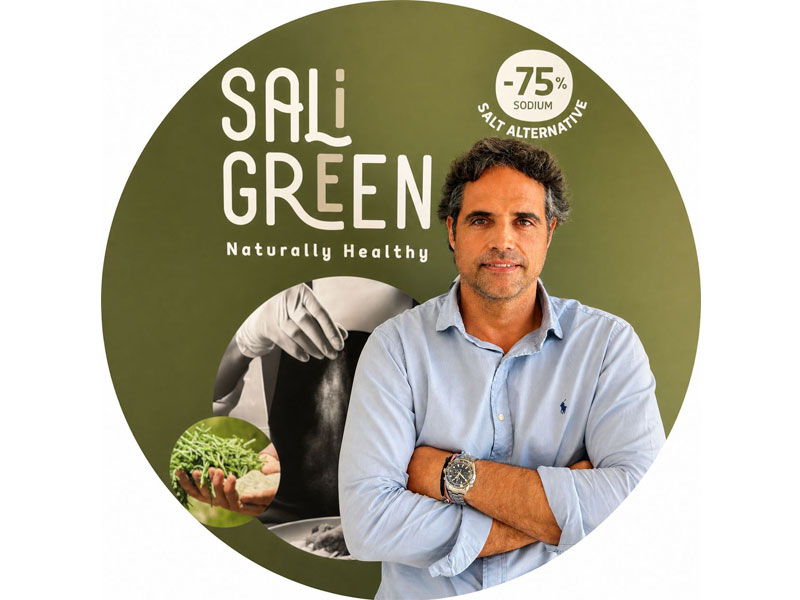
Once harvested and carefully dehydrated, the plant can be transformed into what we call Green Salt: a plant-based seasoning that provides a naturally salty taste while containing approximately 75% less sodium than conventional salt.
This creates a very different proposition from simply asking consumers to use less salt.
The objective is to preserve the pleasure and culinary function associated with seasoning while significantly reducing the amount of sodium being added.
And there is another important difference.
Conventional salt is essentially sodium chloride. Green Salt is a whole plant ingredient and therefore contains naturally occurring components of the plant, including minerals such as potassium, magnesium and calcium, as well as fibre.
This combination illustrates an important direction for food innovation: instead of thinking only about what we need to remove from food, we should also think about what an alternative ingredient can bring to it.
Healthier Food Must Still Taste Good
Reducing sodium is an important nutritional objective, but there is a practical reality that cannot be ignored.
People will not adopt healthier food simply because they are told that it is healthier.
They have to enjoy eating it.
This is precisely why chefs have such an important role to play.
A food scientist may identify an ingredient with an interesting nutritional profile. A farmer may discover how to grow it sustainably. A food company may find a way to process and distribute it.
But chefs understand how to turn an ingredient into an experience.
They understand balance, flavour, texture and expectation.
This is especially important when addressing salt reduction. The future is unlikely to be built simply around telling people to accept less flavour in exchange for better nutrition. Innovation should aim higher: better nutrition without abandoning pleasure.
Sustainability and Nutrition Should Not Be Separate Conversations
For too long, sustainable food and healthy food have sometimes been treated as different subjects.
They are increasingly becoming part of the same conversation.
Consider Salicornia.
From an agricultural perspective, it is interesting because it can grow with saline water and in environments unsuitable for many conventional crops.
From an environmental perspective, its cultivation can be associated with productive saltmarsh landscapes and new approaches to saline agriculture.
From a nutritional perspective, its naturally salty character creates an opportunity to reduce sodium while introducing a plant ingredient containing fibre and naturally occurring minerals.
From a culinary perspective, it offers chefs a new flavour and a new ingredient with which to experiment.
This is the type of intersection that I believe will increasingly define food innovation.
The question should no longer be simply: “Is this sustainable?”
Nor should it only be: “Is this healthy?”
We should be asking: Can it be sustainable, nutritionally interesting, commercially viable and delicious at the same time?
Culinary Schools Can Accelerate Change
This is where culinary education becomes particularly important.
Culinary schools are not simply training people to reproduce existing recipes. They are educating many of the professionals who will influence what restaurants serve, what food companies develop and ultimately what consumers eat.
Future chefs should therefore be exposed to ingredients beyond the traditional culinary repertoire.
They should understand concepts such as sodium reduction, sustainable agriculture, biodiversity, water scarcity and food waste. They should work with farmers, food scientists and ingredient producers. And they should learn to evaluate an ingredient from several perspectives at once.
Where was it grown?
What resources were required to produce it?
What nutritional contribution does it make?
Can it replace or reduce an ingredient that we currently overconsume?
And, ultimately, can we make something delicious with it?
These are culinary questions as much as they are environmental or nutritional ones.
Nature May Already Have Some of the Answers
Food innovation is frequently associated with advanced technology. Technology will undoubtedly play an enormous role in the future of food.
But innovation can also begin by looking more carefully at nature.
There are thousands of edible plants that remain largely outside mainstream agriculture and cuisine. Some are naturally adapted to drought. Others tolerate heat, poor soils or salinity.
As environmental conditions change, these characteristics become increasingly valuable.
Salicornia is only one example.
Its importance lies not simply in whether more people will consume Salicornia in the future, but in what the plant teaches us: we do not always need to change the environment to grow our food; sometimes we can change what we grow.
That shift in thinking could become increasingly important as freshwater becomes more constrained and conventional agricultural systems face greater pressure.
The Chef as a Food-System Innovator
The traditional image of a chef begins at the kitchen door.
I believe the chef of the future must look much further.
Chefs can influence agricultural production through the ingredients they choose. They can help consumers discover unfamiliar foods. They can work with scientists and food companies to develop healthier products. And they can demonstrate that sustainability and nutrition do not have to come at the expense of pleasure.
A small change in an ingredient can have implications far beyond a single plate.
Replacing part of the conventional salt used in a recipe with an ingredient containing substantially less sodium may seem like a minor culinary decision. Multiply that thinking across restaurants, institutional catering and food manufacturing, however, and the potential impact becomes much more significant.
This is why culinary education matters so much.
The next generation of chefs should not only learn how to cook the foods we already know.
They should be encouraged to question ingredients, explore alternatives and understand the consequences of the choices they make.
The future of food will require us to produce differently, formulate differently and eat differently.
The challenge for chefs is to make that future taste good.



.jpg "University of Houston Invests in the Future of Engineering and Nursing")